
I Gave My Website to Three AIs. The Hard Part Was Still Mine.
A field note on building with an AI team — what it amplified, and what it couldn't touch.
I needed a portfolio.
Not a study. Not an experiment. Just a site that looked like me.
But I already knew one thing: I couldn’t get there by handing the whole job to a single AI and chatting my way to the end. I’d done that before. It gets you something. It doesn’t get you something that’s yours.
So I tried a team.
Three AIs, each given the job that fit what it could actually do. Claude Code could touch files, so it built. ChatGPT Image could make pictures, so it made them. Opus was strongest at long thinking, so it planned and wrote.
Not job titles borrowed from a human team. Just each tool, doing what it’s good at.
I went in with three assumptions. Two weeks later I had three answers — and one more thing I hadn’t gone looking for.
It was faster. I still won’t give you a number.
About two weeks. One to get the frame and the story standing. One to push the responsive behavior and the copy to where I wanted them.
For a single page built from nothing — original story, sticky scroll, a live clock, bilingual, fully responsive — that held up against the way this work actually goes when real people do it.
But I can’t give you a multiple.
I once built a four-section WordPress site with a single AI, in about the same two weeks. So I have a comparison.
It just isn’t a clean one.
Different site. Different shape. Different ambition.
So I won’t tell you it was 3x. Or 10x. Anyone who hands you a precise number is comparing real work to a fantasy of how long they imagine it would’ve taken.
Here’s the truer version: same two weeks, different shapes. The team went deep — one page, every inch decided on. The single AI had gone wide — more sections, less depth in each.
Not better. Not worse. Just a choice about what the two weeks are for.
The communication was cleaner than a human team. That part surprised me.
I gave the AIs what I’d give people. A shared folder. A defined place for everything. Files kept in sync. And every time a piece of work closed, I had the AI write the dev log and the spec.
But the real shared document wasn’t the spec. It was the HTML.
The rendered page was the source of truth. Not a description of what we were building — the thing itself. And because every member of this team was an AI, they could all read it directly. No translation. No deck standing in for the work. The source file was the brief.
A human team can’t quite do that. People need the work explained. These three just read it.
So the payoff came in a way a human team never gives you.
Nobody skimmed. Nobody half-listened. Nobody nodded in the meeting and forgot by Monday. The oldest problem with any team — did they actually read it? — was simply gone.
That’s the part I expected to be hard. It was the easy part.
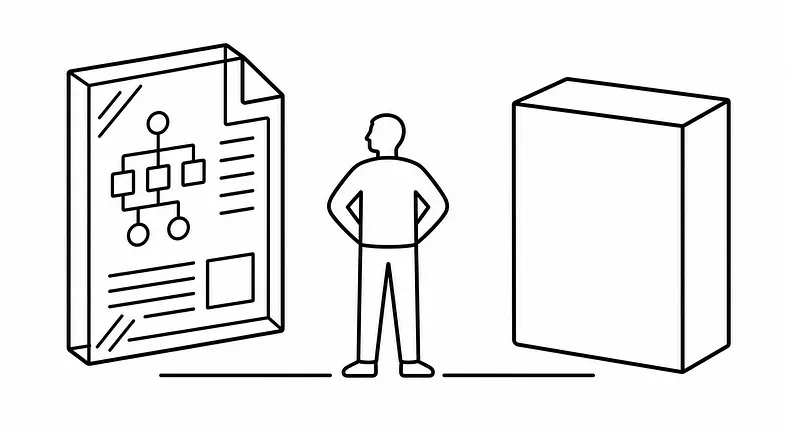
Then it handed me a kind of blindness I’d never had before.
With people, you can’t see whether they read the doc.
With AI, I couldn’t see how it got the answer.
It did the work. It just didn’t tell me how. The shared file was transparent. The machine wasn’t.
There was a spec. There always is. But it kept moving — every decision in the build shifted it a little, and after enough small shifts, the spec in my head no longer matched the thing on the screen.
So I started asking it things. The same things, over and over:
Do you actually understand the problem you’re solving?
Why did you do it this way?
Can you reverse-engineer what you just did, and write the spec back to me?
That last one stuck with me.
Normally the spec comes first, and the work follows. Here the spec wouldn’t hold still — so I kept pulling it back out of the work, after the fact, just to be sure we were still solving the right thing.
I didn’t remove the opacity. I moved it. Off the team, and into the space between me and the machine.
And here’s what makes that space dangerous.
AI is the first tool that argues back.
A hammer doesn’t defend itself. A bad search result doesn’t talk you into trusting it. AI hands you the work — and a fluent, reasonable case for why the work is right.
So the thing you most need to question is also the thing best built to talk you out of questioning it.
Those three questions aren’t a senior person’s trick. They’re just what it looks like to stay awake. Anyone can ask them. Most people, once the work starts coming fast and clean, quietly stop.
Quality? On this one, I get to be the judge.
Some quality has a clean ruler. Mass production has tolerances. A spec has pass and fail. You can measure it without arguing.
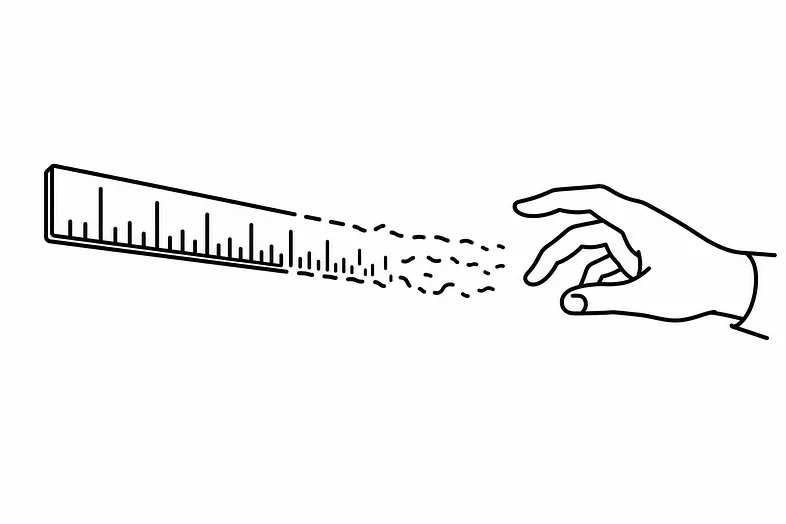
Design quality isn’t quite like that. Whether something feels right — whether it feels like you — there’s no public ruler for that. Someone has to decide. And I picked the one project where the person deciding is me: my own portfolio.
And I’m happy with it. The way it looks. The way it moves. Whether it does what I built it for.
Because it’s mine, I get to say that without hedging.
But I’ll be honest about where the quality came from.
Some of it is the team — the speed, the hours it saved.
The part that makes it feel like me — that wasn’t the team.
That was me.
A single AI, in my hands, would probably have gotten just as far. The quality was never in the lineup of models. It was in the person in the middle.
The thing I didn’t go looking for
All three assumptions held. The experiment worked.
That’s the least interesting thing I can tell you.
Because look at how the work actually split.
Claude Code wrote the code — but the page started as a concept I’d shaped first. ChatGPT Image made every picture — to a direction I’d set. The story came from no single model. It took shape across conversations, back and forth, until it held.
Every layer had an AI on it.
And every layer had me on it too.
Nothing here got handed off and walked away from.
So this is what I’d tell anyone trying the same thing: an AI team doesn’t fill in what you’re missing. It scales what’s already there. The judgement. The taste. And the blind spots, right alongside.
It’s a magnifying glass. Not a flattering mirror.
You come back larger. You don’t come back different.
I still ask it those three questions.
Not because I’m sure I’ll catch the moment it’s wrong.
Because I know exactly how good it is at making me feel like I don’t need to.
The site is the one I built this way: altimn.com. If you use AI in your own work, I’d genuinely like to know — do you still ask it those three questions? Or have you gotten comfortable enough to stop? Tell me what your version of them is.